The Painful Relevance of Heated Rivalry
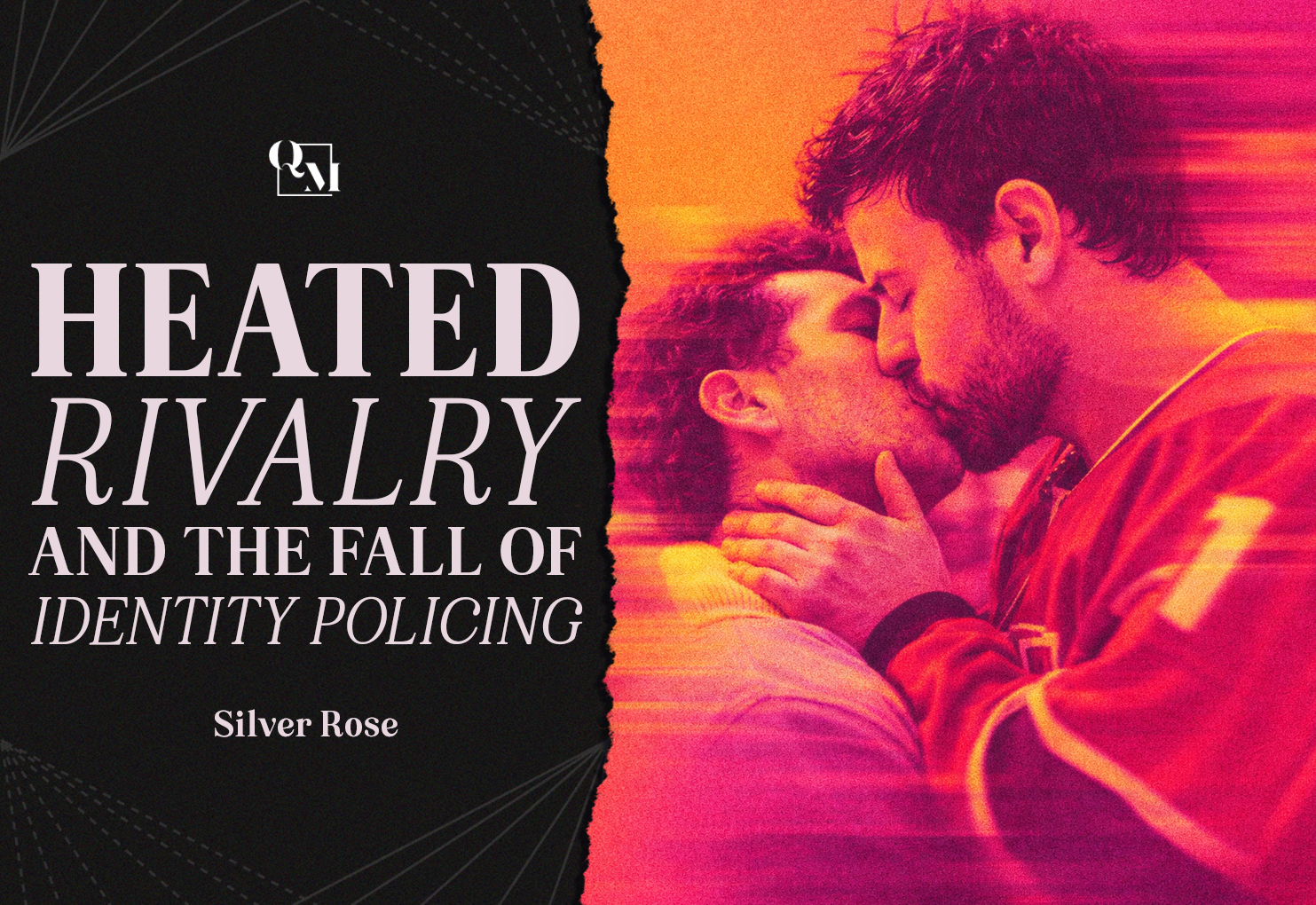
Where are all the gay hockey players? Surely they exist, and yet hockey remains the only major sport without any openly bi or gay players at the highest levels. This scarcity of queerness in hockey, and the game’s distinctly traditionalist culture, leaves a gaping and conspicuous void that opens itself to all manner of speculation — what fandoms now call “shipping.” What if, for example, Sidney Crosby and Alex Ovechkin — two generational superstars, one a reserved Canadian and the other a colorfully gregarious Russian, whose prodigious successes and intense rivalry shaped an entire era of hockey — were secretly lovers? That’s the premise of Heated Rivalry (2025–), the sizzling romance series the Internet can’t stop talking about. But beneath the show’s steamy exterior, it grapples with the agonizing tensions and pressures that many players whose names and stories we may never know have had to live with.
Produced for the Canadian streaming service Crave and quickly picked up by HBO Max and other platforms around the world, Heated Rivalry, based on Rachel Reid’s Game Changers series of romance novels, tells the story of Shane Hollander (played by Hudson Williams) and Ilya Rozanov (Connor Storrie). Rivals from before they were even drafted (going first and second overall), Shane and Ilya soon find that despite being bitter on-ice enemies, they are drawn toward, fascinated with, and irrepressibly attracted to one another. The show follows them over a period of years as their careers, lives, and love progress.
This review contains some spoilers for season one.
Of course, what has grabbed most of the attention is just how explicit the show is. Large stretches of the first couple of episodes are tantamount to softcore gay porn. No mainstream series or film about sports has ever even come close to depicting this much gay sex. Shane and Ilya don’t play zone defense. It’s 100% man-on-man. But Heated Rivalry is about much more than sex.
Shane Hollander is the perfect little Canadian boy. Polite, mild-mannered, agreeable, and micromanaged by his PR-minded parents, the young phenom has all the makings of the next face of Major League Hockey (the fictionalized version of the National Hockey League). Ilya Rozanov, on the other hand, is a hockey rock star. A puckishly carefree ladies' man who parties as hard as he plays, the Russian scoring dynamo never seems able to escape his troubled family life back home. In one another, Shane and Ilya find more than just passion and connection — they discover the deepest version of themselves.
In contrast with so many other romance tales, Heated Rivalry’s “will they/ won’t they” isn’t about whether Shane and Ilya will hook up — they do it early and often — but whether they’ll let their relationship blossom into its full potential. What begins as a purely physical infatuation between the two players evolves over the years into a close friendship with benefits and eventually, through much turbulence, avoidance, and denial, into something much more.
As the show peels back the layers of the characters and slowly unfurls the depth of their relationship and feelings, everything is turned on its head. We see Shane’s courage of boldness, Ilya’s vulnerability and sincerity, and an on-screen chemistry to rival anything shown on film or television. The characters are played to perfection, capturing every intricacy not only of intimate romance but also the many little mannerisms, facial expressions, and voice inflections common among hockey players in different countries. Williams and Storrie did their homework.
Though I doubt most viewers are tuning in for the sports, the hockey itself — such as it is — leaves much to be desired. Sequences involving hockey gameplay are filmed like aging Steven Segal fight scenes — lots of quick cuts and handheld close-ups designed to, but never quite succeeding at, disguising the talent’s inability to perform the feats we’re supposed to be watching. To be sure, the actors are competent skaters, but they lack the natural grace of any serious player, much less a professional. Indeed, the shots mimicking televised hockey broadcasts — in which camera and editing trickery are impossible — look like watching an over-40 beer league. That said, the show actually features very little hockey play. Hockey is integral to the setting, plot, and character dynamics, but in a sense, Heated Rivalry is a show set against the backdrop of hockey, not Ted Lasso (2020–) on ice. It’s a “hockey show” the way Casablanca (1942) is a “war film.” At bottom, it’s a story about navigating same-sex relationships in the world of hockey.
In one particularly moving scene, Shane’s short-lived attempt at a straight relationship with actress Rose Landry (Sophie Nélisse) falls apart when it becomes clear that he’s simply not attracted to women. As the remixed t.A.T.u. song blares in a nightclub when Shane and Ilya cross paths with their respective dates, “This is not enough.” Shortly thereafter, Shane comes out as gay to Ilya. Though the show never uses the term, Ilya is bisexual and is portrayed as such throughout. Watching in today’s day and age, it is rather amusing to see Shane acknowledge being gay to his male lover of nearly 10 years, but within the context of hockey culture, it rings eerily true, as does the fact that neither player publicly comes out at any point in this first season.
While online hockey fan spaces have become remarkably woke in recent years, the Internet is not real-life, and in person, hockey culture remains, as it has long been, quite conservative. Hockey is one of the only secular subcultures in North America where social norms in the mid-2020s seem like a time-warp from a previous era. Few NHL players ever go to college, most are married with children by age 25, and individuality is frowned upon. Above everything, a unique blend of unbridled athletic machismo, ingrained stoicism, and Canadian restraint fuse to create the perfect disincentive for any expression of queerness. Beyond the NHL’s progressive marketing campaigns, pro-LGBT initiatives like “You Can Play”, and rainbow-themed “Pride night” games, the tens of thousands of guys who comprise professional hockey at the highest levels are old-school, 20th-century men, even if they were born in the 21st.
Distilled to its essence, hockey culture is fundamentally shaped and maintained by the sensibilities and tastes of mildly brain-damaged Canadian rednecks whose testosterone levels are inversely correlated with their number of teeth. “Faggot” is a ubiquitous epithet in the sport that has only in the past decade been purged from the NHL for public relations purposes, but at every other level, it still flies from players’ lips as readily as spit. I’ve been an ice hockey fan for over 30 years, and a player for 15 (as recently as 2021). I even refereed for a year in the 2000s. I’ve heard every imaginable racial, ethnic, and religious slur in locker rooms, on the ice, and in the stands more times than I can count. Homophobia is no exception. It was — and in most areas of hockey, still is — everywhere, as though woven into the fabric of reality. It’s a large part of why, even while Heated Rivalry blazes through pop culture like a wildfire, it is hardly mentioned and certainly not celebrated in hockey circles.
Secondary to the main storyline of Shane and Ilya, the show also features one of Game Changers’ other protagonists, veteran player Scott Hunter (François Arnaud), who is also gay. He falls in love with Kip (Robbie G.K.), the guy who makes his pre-game smoothies, and unlike with Shane and Ilya, this relationship gets serious right away. However, with Scott feeling unable to come out, the stress and secrecy takes its toll as the couple go through the uncomfortable strain of living double lives. Eventually, in the penultimate episode, when Scott leads his team to a cup championship, he invites Kip onto the ice from the stands and, on national television, shares a passionate kiss. It’s a moment many viewers wish could have belonged to Shane and Ilya, themselves watching from their respective homes in shock. Scott goes on to become a sort of ambassador for greater LGBT inclusion in the game, a mantle Shane and Ilya aren’t yet ready for.
The final episode of the season is the emotional climax. Inspired by Scott’s coming out, Shane and Ilya spend the summer at a secluded cottage together, the first time in their decade-long relationship in which they are simply alone in one another’s company for an extended period — until they’re discovered by Shane’s father. In a tearful and moving moment with his mother, Shane says, “I need you to know that I did really try [to be straight]. I tried really hard, but I just can’t help it. And I’m sorry.” It’s heartbreaking to think about how many players must still feel as he does, even today. That shame envelops them both and permeates the relationship in ways they only begin to dismantle at the end, giving viewers a tantalizing glimpse at what the recently green-lit second season will explore.
Interestingly enough, the success of Heated Rivalry may end up improving hockey, not only by growing the number of fans, but also by nudging the norms in a more open-minded way. It may even give that critical first player the courage to come out. I hope the day soon comes when fictionalized secret relationships like Shane and Ilya’s seem historical rather than painfully relevant. In the meantime, we can all watch the unlikeliest hockey hit in television history.
Heated Rivalry (2025–)
Published Dec 30, 2025