
Ukraine, Chechnya, and the Cost of “Peace”
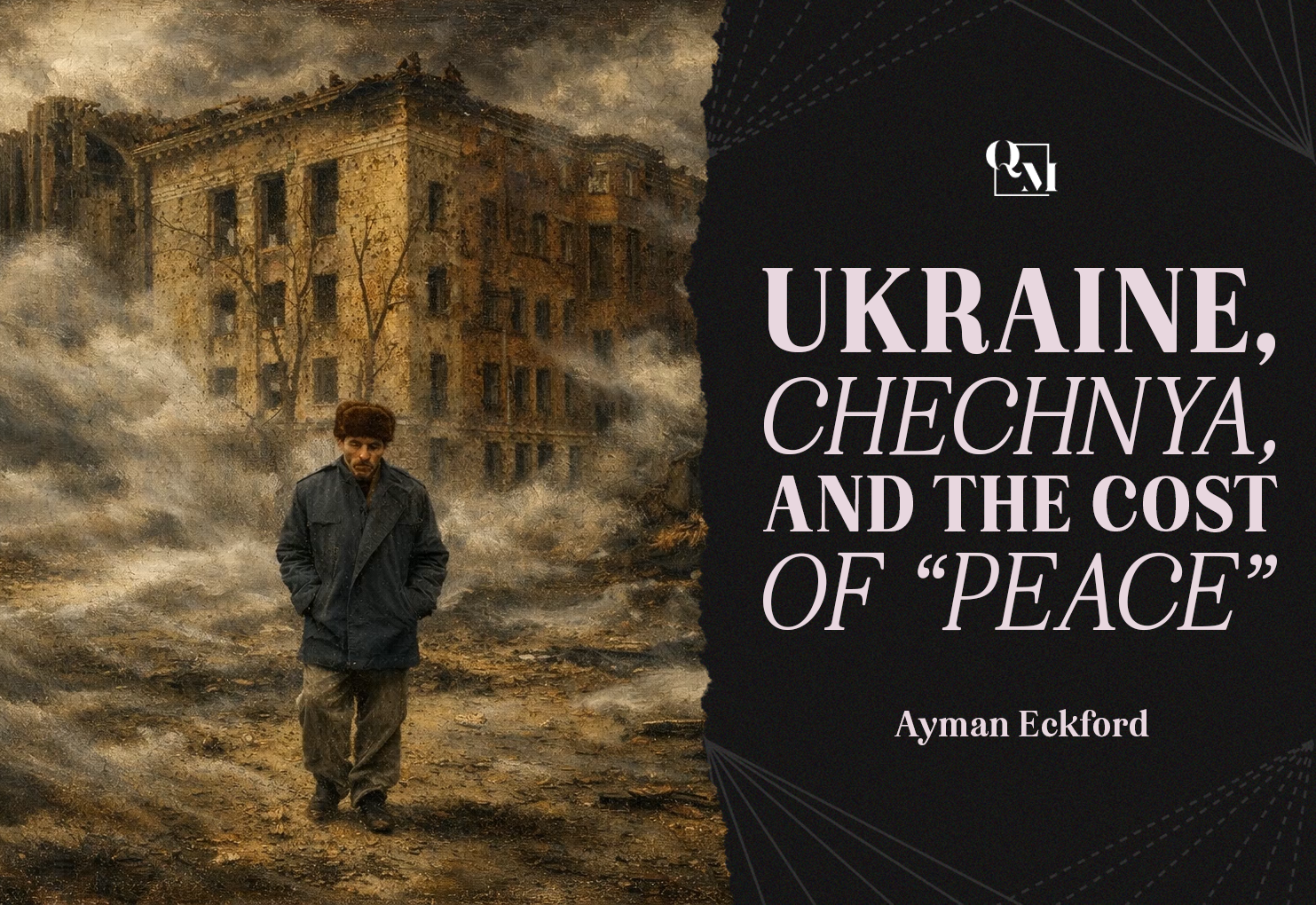
When Donald Trump and Vladimir Putin met on the red carpet for their Alaska summit in the summer of 2025, the meeting was supposed to be dedicated to finding a peaceful resolution to the war in Ukraine. Instead, the summit turned into the Russian president’s attempt to push the US into accepting “compromise” over Ukrainian territories. While many Americans and international observers felt outraged at this blatant disregard for Ukraine’s sovereignty and for the principles of democratic alliances, this proposed “compromise” wasn’t only about Ukraine. The US was also being steered toward compromising on the foundational ideals of liberty and human rights — values that dictators like Vladimir Putin, and the Russian leadership in general, have never respected.
Nowhere is this more evident than in Russia’s behavior in Ukraine. In the Ukrainian territories Putin has seized, Moscow has exported its so-called “Russian values” agenda, attacking LGBT people, silencing queer communities, and criminalising their very existence. These are the individual lives and freedoms now treated like bargaining chips. To many who do not closely follow Eastern European politics, this may appear sudden or unexpected, but it’s sadly part of a long pattern in the post-Soviet world.
Russian militarism did not begin with Ukraine. Soon after the USSR collapsed, Russia attacked another weaker post-Soviet country left unprotected by international alliances: Chechnya. As a journalist from the region who has reported on Chechnya for years, covered Chechen-Ukrainian relations for the Ukrainian think tank Solid Info, and developed deep ties with the Chechen diaspora, the situation in Ukraine felt like déjà vu. It was Chechnya all over, and the international community let it happen by agreeing to Russian “compromises.”
On September 6, 1991, a month into the Chechen revolution, the All-National Congress of the Chechen People declared its independence from Russia, establishing the Chechen Republic of Ichkeria. Just weeks prior, Ukraine had declared its own independence. The Soviet Union was collapsing, and Soviet leader Boris Yeltsin encouraged its former republics to “take as much sovereignty as you can swallow.” Like the Ukrainians, the Chechens had survived genocide under Joseph Stalin. But unlike Ukrainians, Chechens were not a Slavic people. Their language belonged to an entirely different family, their culture was distinct, and even their religion was different (predominantly Muslim rather than Christian).
Chechen society is also one of the most individualistic cultures in the region. Ever since the early Middle Ages, Chechens had no hereditary nobility, choosing their leaders communally. In contrast to many of their neighbors, Chechnya also has a long-standing inclination toward personal freedom over collectivism and family over the state as the enforcer of cultural norms. Because of widespread anti-Muslim stereotypes, however, this aspect of Chechen culture is often overlooked. In fact, I have been struck more than once in the course of my work by the fact that Chechens resemble Americans in some respects much more than they resemble Russians.
The issue of LGBT rights, for example, was traditionally considered a private, family concern in Chechnya. Indeed, Chechens generally avoid discussing sexual matters in public because such topics are considered too personal. This does not mean they were LGBT-friendly, but it meant there was, at least, no state interference in private life. The same cannot be said for much of the region. In Chechnya, homophobia was more likely to manifest in privately handled family disputes as opposed to physical attacks in the street. That distinction disappeared under Russian occupation.
Modern Russia invaded Chechnya twice. The First Russo-Chechen War (1994–1996) ended in a Chechen victory and a peace treaty, but in 1999, Russian forces invaded again. What transpired says a lot about what “peace” on Russia’s terms actually entails.
The Second Russo-Chechen War (1999–2009) and subsequent occupation gave rise to a previously little-known politician, Vladimir Putin, whose dramatic ascent was built on the mass killing of civilians and the destruction of Chechnya. Under Putin’s leadership, Russian soldiers carried out massacres in villages and abducted Chechen men en masse under the guise of “anti-terrorist operations” — which in practice meant torture, rape, and murder. Despite the brutality, the war was strongly supported across Russian society, even among most of the anti-Putin opposition — imperial nostalgia and post-9/11 Muslim moral panics saw to that. For example, Mikhail Khodorkovsky — later hailed in the West as one of Putin’s fiercest opponents — once justified the second Chechen war in very Victorian terms, saying that he would fight to keep Chechnya because the Russian Empire conquered the Caucasus. The problem is, it was no longer the 18th century, but the 21st, and this man called himself a liberal.
This is the real reason for the wars in Chechnya and in Ukraine — not the fear of NATO, but the age-old Russian imperialist mindset.
Russian troops next to a mass grave in Chechnya, February 2000. Source: Wikimedia Commons.
In Chechnya, leaders like Zelimkhan Yandarbiyev, the second president of the Independent Ichkeria who cited Friedrich Hayek in his writings, were smeared as “Islamic terrorists.” The international community went along with this characterisation so as not to make Russia angry. Putin then installed Akhmad Kadyrov, a former Ichkerian religious leader-turned-collaborator whom many suspected of KGB ties in the Soviet era.
When I reached out to Chechen sources to ask how Kadyrov “won” elections during wartime, they told me stories of Russian soldiers threatening their parents and grandparents. People voted for Kadyrov and for “joining Russia” because they feared their children would be killed or their homes burned. After Akhmad’s assassination, his son Ramzan inherited the leadership of the Russian Federation’s government in Chechnya.
Occupation brought new forms of humiliation. Russian prison culture introduced the systematic rape of men — a practice unknown in Chechnya — as an additional torture for kidnapped civilians. This created new, toxic associations with male same-sex relationships. The Russian occupational regime also destroyed Chechnya’s traditional boundaries between private and public life. The police — which were officially under the command of Russian law enforcement — began checking young men’s phones, first for political messages, opposition media, or “unauthorised” and “radical” religious content. Later, they also checked online dating sites. This led directly to the infamous anti-gay purge, documented in HBO’s Welcome to Chechnya (2020), during which dozens of men accused of being gay or bisexual were arrested and tortured.
But this campaign showed only one part of a broader system of repression. In occupied Chechnya, anyone “different” could be targeted: men with the “wrong” kind of beard, women wearing clothing that was either too Islamic or “too Western”, atheists, Muslims following “unapproved” religious traditions such as Salafism, people listening to banned music or reading forbidden books, and even the relatives of kids who made political jokes online.
The dozens of Chechens I spoke with told me that there was nothing “Chechen” about the Putin-installed Kadyrov. He and his son have always been seen as outsiders and occupiers, hated by both liberals and conservatives, Sufis and Salafis, believers and atheists, young and old. Yet because of the Russian policy of collective punishment in which entire families are punished for any offense of one member, open opposition is almost impossible.
A Russian soldier standing on a Chechen mass grave, c. 2000. Source: Wikimedia Commons.
Western media, however, has often misrepresented the situation. For example, the aforementioned documentary Welcome to Chechnya, made by the American journalist and filmmaker David France, was one of the first pieces of reporting that most young Western liberals and LGBT activists saw on the Chechen occupation. In interviews with young adults in the US and UK, I asked whether they were aware of the situation in Chechnya and the problems Chechens have faced under Russian control. The most common response was, “Yes, we heard that in Chechnya their leader is killing gay people.” That is the extent of their understanding. There is no broader context — no clarification that it is in fact not a “Chechen leader” but a puppet placed there by the Russian occupational administration, nor that the violence and oppression extends far beyond gay people.
When I asked these people where they were getting their information from, over and over, the film Welcome to Chechnya was mentioned.
I was living in Russia when this documentary was made. I knew some of the Russian LGBT activists who were leading the LGBT organisation mentioned in the film. And while that group really did save lives, their leader was viciously xenophobic toward Chechens and ignored the voices of Chechen LGBT people. Ethnically Russian activists without deep knowledge of Chechnya or respect for Chechen culture worked side by side with the HBO filmmakers who translated, repackaged, and distributed Russian anti-Chechen propaganda to the West. Welcome to Chechnya portrayed Chechens as barbaric and uniquely homophobic, ignoring the reality that many LGBT Chechens were saved by their own families. Russian activists, meanwhile, were shown as heroes.
The film strips the story of its crucial context, without including the non-LGBT victims of repression. The impact of the film in turn created suspicions among Chechens, fueling conspiracy theories about a “Western gay lobby” and generating a self-fulfilling prophecy. Russian propaganda happily exploited this, convincing Chechen prisoners that the West only cared about gay Chechens and not about “ordinary” ones. As a result, anti-LGBT rhetoric and language began proliferating even in Chechen pro-independence social media channels in which the LGBT community was seen as a proxy for Russian propaganda with “accidental” help from the West.
Now we see history repeating itself. In the Russian-occupied parts of Ukraine, LGBT people live in terror, targeted as part of a wider campaign of mass repression against minorities. Once again, Moscow is using occupation not only to control territory, but also to oppress those who are different and erase non-Russian cultures. And the American government seems ready to sacrifice the individual liberties of all citizens in the Donbas and Crimea for the sake of “compromise.” This overlooks the fact that, like the Chechens, the people of Ukraine have the right to decide their own fate in the face of Russian aggression, and to fight for their freedom and autonomy. Many pontificate about the need for “peace” in Ukraine, but if Russia is allowed to set the conditions, the outcome could make what has happened in Chechnya look like a walk in the park.
Published Jan 09, 2026


