
Heated Rivalry and the Fall of Identity Policing
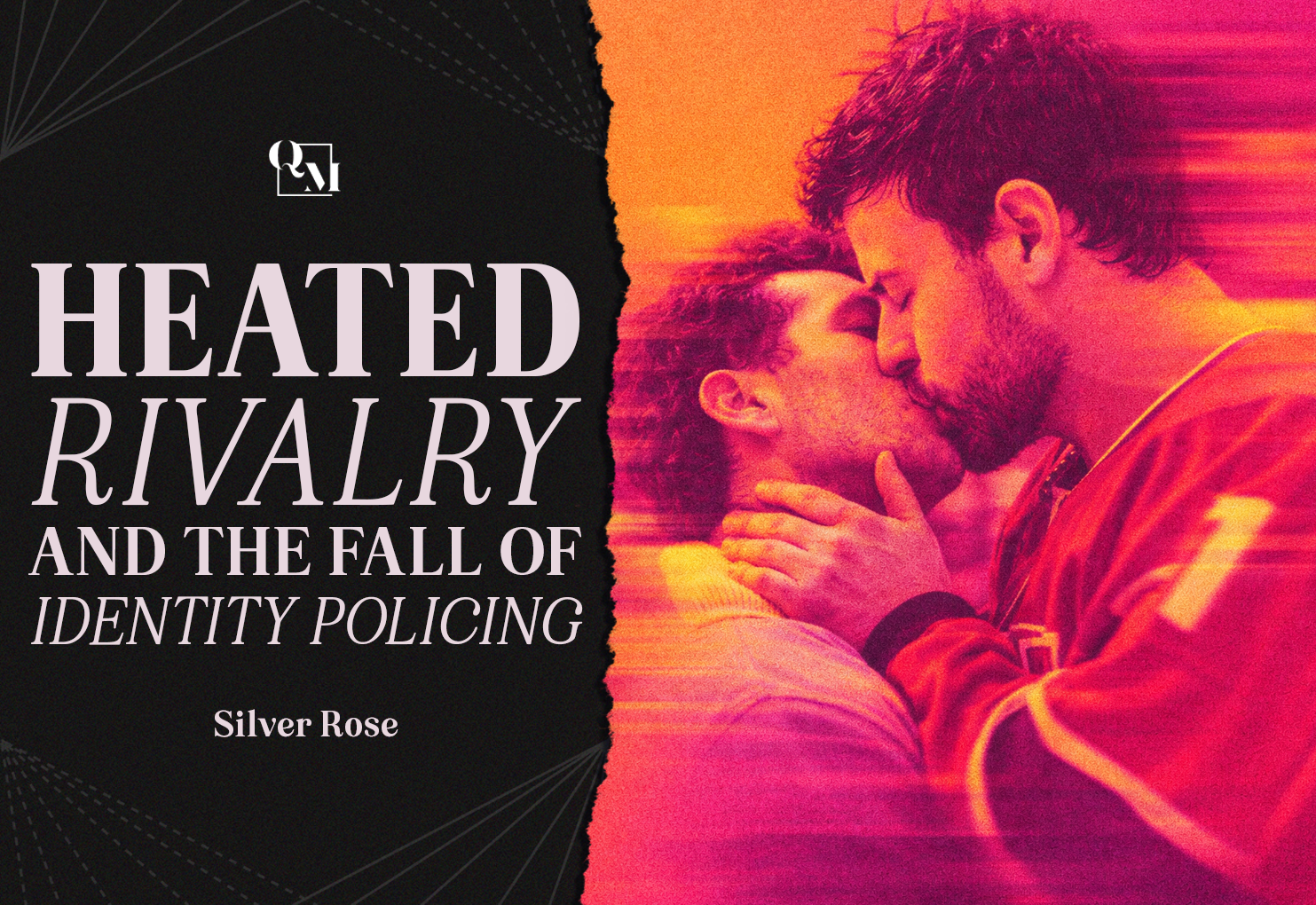
When Heated Rivalry (2025–), a steamy gay-hockey romance adapted from Rachel Reid’s Game Changers series, premiered this November on Crave and HBO Max, audiences quickly latched onto the chemistry between rival professional players Shane Hollander and Ilya Rozanov, played by Hudson Williams and Connor Storrie. As the series gained traction for the leads’ explicit romance and on-screen hotness, discussions in fan spaces and entertainment coverage drifted beyond the show itself. With both actors declining to publicly label their sexualities, a familiar question emerged: are Williams and Storrie gay or bi in real life? And if not, are they guilty of “queerbaiting”?
When the question was put directly to the show’s creator, Jacob Tierney, he rejected the premise outright. Asking about an actor’s sexual orientation, he noted, is illegal in a hiring context and also beside the point. What matters, Tierney emphasized, is an actor’s talent, enthusiasm for the role, and willingness to do the work. That response largely ended the conversation. Subsequent coverage framed Tierney’s intervention as protective rather than evasive, emphasizing the impropriety of pressuring actors to disclose their sexual orientation. There was no moral panic. No mass hashtag campaigns. Instead, the act of asking became the story: a relic of an earlier era of overbearing identity policing. The collective eye rolling with which this behavior is now met marks a subtle but meaningful shift in how audiences talk about authenticity and queerbaiting in contemporary media.
To understand why this reaction is noteworthy, it helps to revisit how queerbaiting became a cultural flashpoint in the first place.
The term “queerbaiting” was popularized in the early 2010s through online fan communities to criticize shows that hinted at same-sex attraction without following through. Around the same time, the #OwnVoices movement gained traction in publishing, advocating for stories about historically marginalized groups to be told by creators from within those communities. While initially focused on amplifying underrepresented writers, the idea gradually expanded into a broader cultural expectation about authenticity.
As critics such as Kat Rosenfield have noted, fandom culture was an especially intense incubator for these norms, increasingly collapsing the distinction between fiction and endorsement and treating characters’ dialogue (including villains) as transparent reflections of authors’ moral beliefs rather than narrative devices. Within this ecosystem, demands for authenticity hardened into informal moral tests, and suspension of disbelief came to be viewed with suspicion.
This logic dovetailed with, and was adjacent to, contemporaneous debates over cultural appropriation, which reframed representation as an ethical problem of ownership rather than craft. The term emerged from academic discussions about colonialism, but by the mid-2010s, it had moved well beyond that context and into everyday coverage of media, fashion, music, and celebrity culture, where identity was prioritized over intent. By 2015, cultural appropriation discourse was sufficiently mainstream that Yale University administrators circulated a campus-wide email ahead of Halloween, urging students to avoid “insensitive” costumes such as feathered headdresses. When Erika Christakis, a lecturer at the school, publicly questioned the letter, hundreds of students reacted by organizing protests, chanting “Our Culture is Not a Costume” and publicly demanding that she and her husband (a faculty head at Yale) be fired. They both stepped down from their teaching positions amid the fallout.
A pivotal mainstream flashpoint for the “queerbaiting” strain of social justice identity policing arrived with Call Me By Your Name (2017). While the film was widely praised for its tenderness and poetry, it also ignited a sustained debate over whether gay roles should be played exclusively by gay actors. Criticism focused less on the film’s content than on the identities of its leads, particularly Timothée Chalamet, with some arguing that casting presumed-straight actors perpetuated a long history of queer stories being filtered through non-queer perspectives.
Crucially, this debate unfolded against the backdrop of the #OscarsSoStraight and #OscarsSoWhite campaigns, which had already reframed awards culture around questions of representation, access, and systemic exclusion. Although Call Me By Your Name featured a same-sex romance and received multiple Oscar nominations, it was nonetheless absorbed into a moment when authenticity itself had become a dominant evaluative lens. Representation was no longer just about what appeared on screen, but about who embodied it and whether institutional recognition was reinforcing or correcting historical inequities. The question shifted from how a story was told to who was telling it.
What made Call Me By Your Name distinctive was not the presence of dissent, but how mainstream it became. Questions about actors’ sexuality migrated from online fandoms into mainstream media coverage, signaling that concerns once confined to Tumblr or Twitter were now shaping editorial judgment in legacy outlets.
By the early 2020s, the scrutiny intensified. When Netflix’s Heartstopper debuted in 2022, lead actor Kit Connor was pressured online to clarify his sexuality and ultimately came out as bisexual, describing the experience as coercive and harmful.
This discourse often tipped into the absurd. For instance, Taylor Swift has been repeatedly accused — in outlets including the New York Times — of queerbaiting based on pro-LGBT symbolism and behavior such as… publicly hugging her female friends.
In light of that context, the subdued reaction to Heated Rivalry is striking. What might once have sparked backlash instead passed with little controversy, suggesting a growing fatigue with maximalist identity policing and a broader recognition that compelled disclosure often harms the very people it claims to protect, not to mention alienating the general public.
This shift is also inseparable from the wider political moment. As right-wing reactionary politics have grown more aggressive and culturally dominant, disputes over symbolic “authenticity” increasingly feel misaligned with more urgent issues. The stakes of representation have not disappeared, but the appetite for turning every casting decision into a moral referendum has noticeably waned. In its place has been a modest return to first principles: craft. Acting is, by definition, the art of pretending. Demanding that performers mirror their characters’ identities collapses the imaginative distance that makes cinema possible. When audiences fixate on actors’ biographies rather than their performances, they erode the suspension of disbelief on which storytelling depends.
Seen this way, the reaction to Heated Rivalry marks a maturation of Queer Representation discourse. Authenticity is once again being located not in personal disclosure, but in the quality of the work itself: a shift that ultimately benefits art, audiences, and actors alike.
Published Dec 24, 2025


