Queer People Don’t Need “Holiday Survival Guides”
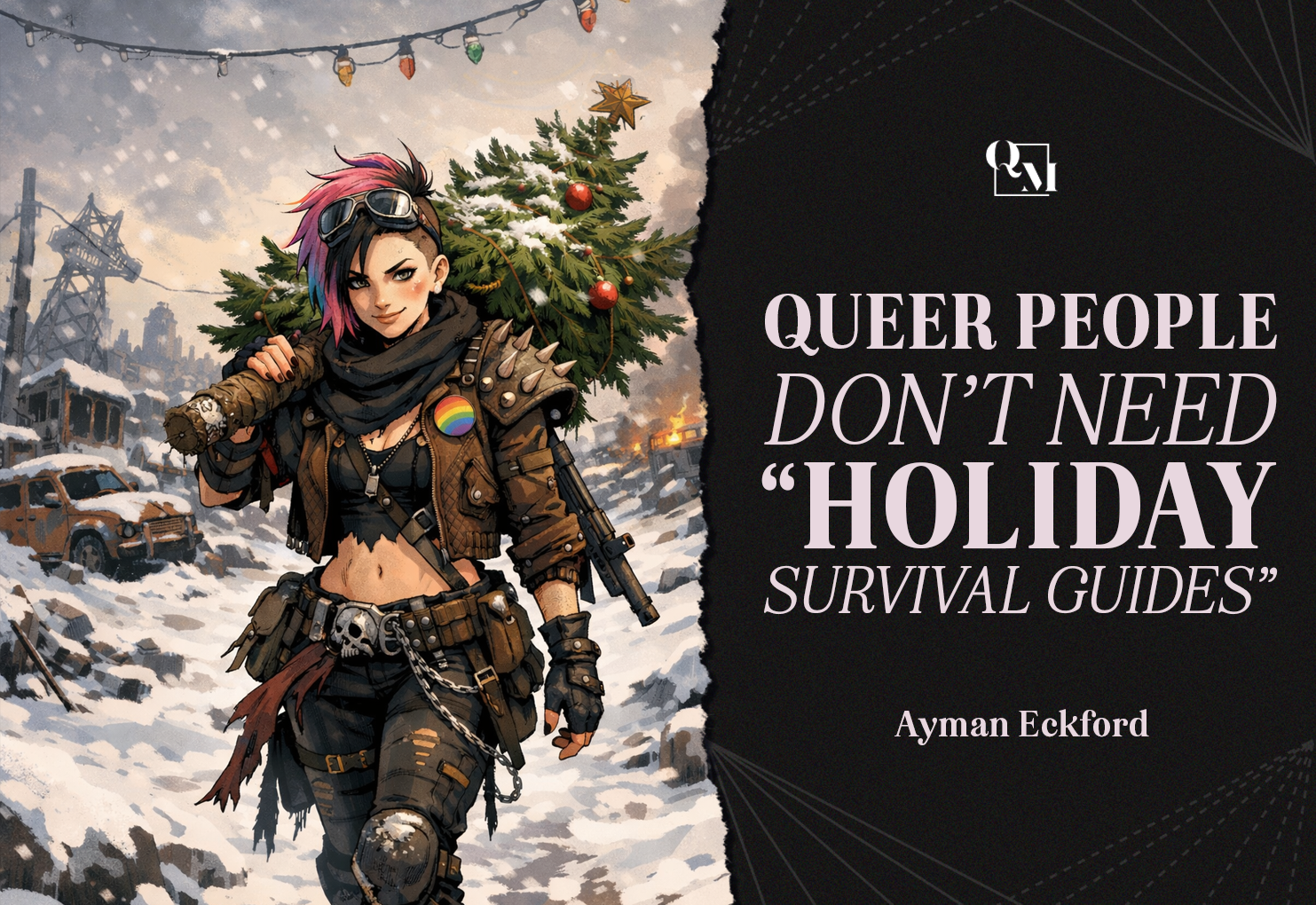
How can we “survive” this Christmas? Toward the end of every year, we see a deluge of articles addressing this question. If you read LGBT publications in particular, you might well decide that the holiday season is a crisis on par with a global pandemic or a natural disaster. I sometimes think that if people from a parallel universe without winter holidays read only our contemporary queer Christmas “survival guides”, they would assume exactly that.
I’m guilty of fueling this narrative myself. I’ve written several op-eds about how to survive the holiday season for people who have a difficult relationship with their parents, or who are estranged from them, or who live with religious trauma. And honestly, I am one of those queer people, too. My religious scars run deep. I was raised in an abusive, deeply conservative Christian family with whom I’m now estranged. The holidays can still feel hard.
As a child, I was tormented by religious fears. At one point, I was genuinely scared to write the word “god” without a capital letter, lest I incur divine judgment. As a teenager, my fear of God grew so strong that I began praying dozens of times a day, unable to read, watch movies, or do homework. I was later diagnosed with severe obsessive-compulsive disorder and post-traumatic stress disorder, partly caused by religious trauma. I’m also a trans person with a bisexual wife. So I understand very well why so many queer people dread December.
But while this time of year can be difficult, the way we talk about the holidays — especially in LGBT media — often turns them into something bigger, darker, and more all-consuming and catastrophic than they actually are.
Let’s start with some data, because the facts matter here.
Christmas is not a suicide season. Despite the widespread cultural belief that suicide rates spike during Christmas and New Year’s, research consistently shows the opposite. Suicide rates in the UK, the US, and much of Europe are, in fact, lower during December and around major holidays than at other times of the year. Multiple long-term studies show a decline in suicides in the days leading up to and during Christmas, with rates often rising later in winter or in spring instead. A US study found suicide rates fall before and during Christmas and increase afterward. European research, including Austrian national data, shows that suicides reach one of their lowest points around December 24. Policy experts have repeatedly debunked the “holiday suicide spike” myth, explaining why it persists despite evidence to the contrary.
Source: Annenberg Public Policy Center and CDC.
This does not mean that LGBT people — or anyone from troubled families or abusive religious communities — don’t struggle during the holidays. It means that portraying Christmas as a uniquely lethal season is inaccurate — and often unhelpful.
LGBT people do face a higher risk of suicide, but not because of Christmas. Gay, lesbian, trans, and especially bi people have a higher baseline risk of suicidal ideation and self-harm overall. That part of the narrative is real and serious. LGBT people are also more likely to suffer from religious trauma. According to the Global Centre for Religious Research, religious trauma “results from an event, series of events, relationships, or circumstances within or connected to religious beliefs, practices, or structures that is experienced by an individual as overwhelming or disruptive and has lasting adverse effects on a person’s physical, mental, social, emotional, or spiritual well-being.” Millions of LGBT people in America and elsewhere live with these aftereffects, especially those who experienced conversion therapy, rigid gender roles, bullying, or abuses tied to faith.
For centuries — and still today in many places — gay and lesbian people have been reviled as sinners by the church and society. On top of that, bi people in particular have long been framed as unstable, promiscuous, or spiritually wayward — never quite pure enough for mainline churches, and often dismissed even within queer spaces. And, of course, the wave of hostility trans people now face in the US is deeply intertwined with Christian conservatism and the evangelical right. It’s unsurprising then that Christmas can dredge up a lot of anxiety and bad memories, and why many people find no joy hearing hymns in supermarkets, gathering with relatives, or listening to the moralising insistence that this season is all about “love.”
Another group that may view the holidays negatively are LGBT people who have been rejected by their families. For example, despite bisexuality becoming increasingly normalised, many traditionalist or religious parents still reject their bi children. Sometimes this takes the form of outright hostility, in other cases it manifests as quiet disapproval or looking the other way, but rejection is rejection. While the culture loudly celebrates family unity, many young bi adults from religious backgrounds spend December apart.
That loneliness is real. But it’s not the whole story. Adult life comes with the ability to make your own choice.
One reason holiday “doom” has become its own genre is that we too often forget a basic truth: adults are allowed to not celebrate holidays. In a perfect world, the freedom to reject or change religions would be afforded to people of any age, but in the (Western) world we currently live in, adults at least have this power.
You don’t owe the Christmas season anything. Christmas is not an inescapable monster that you must let devour your time and energy. You don’t owe it joy, participation, or suffering. You can decide what to do with your time and money this December, and you can set up boundaries. And if you do decide to celebrate, you can redefine it completely or create entirely new traditions. I celebrate Christmas now as an agnostic, in my Stranger Things “Hellfire Club” jumper, listening to metal, nowhere near a church. Many of my friends go to queer spaces at Christmas. Others stay home. For some, Christmas means a drag show or a gay bar. Or it means dinner with people who chose and accepted us, not people who raised and rejected us. These are normal, healthy, adult choices.
Bi people, and queer folks as a whole, are experts in building new traditions and family structures. These relationships are not necessarily weaker than biological ones: they are often stronger, because they are chosen and made with intention. After all, no one chooses their genetics. Even Ted Bundy and Osama Bin Laden had children, but their children were not doomed to follow in their footsteps. To the contrary, Bundy’s daughter and some of Bin Laden’s children have gone to great lengths to distance themselves. This isn’t to say that Christian conservative families are morally equivalent to serial killers or terrorist masterminds. The point is that we are not defined by our blood and can choose a new path.
Found families exist because they have to. Because safety matters more than convention. Because belonging should not come with conditions. For many queer people, spending Christmas with friends, partners, or community groups is not a sad substitute for biological family; it’s every bit as meaningful to them and deserving of respect.
All of this being said, it’s undeniable that being gay or bi has become a lot easier. Compared to years ago, you'll find far more people accepting you this Christmas, from friends, to colleagues, to relatives, and even many communities of faith. The society many of us remember from our youths has profoundly evolved. We now live in a culture that features bi and other LGBT characters in romcoms and Christmas programming, where a commanding majority of society approves of equal rights. Today, society includes us during the celebration, and that matters.
So, how can you survive Christmas? Here’s the unsatisfying answer: you don’t need to “survive” it. You can ignore it. You can reimagine it. You can celebrate it quietly or go to the parties. You can mourn what you didn’t have growing up and still enjoy what you’ve built. If you decide to celebrate, do it your way. With your people. With your music. With your boundaries intact.
Published Dec 18, 2025