The Unkillable Symbol of Bita Shafiei
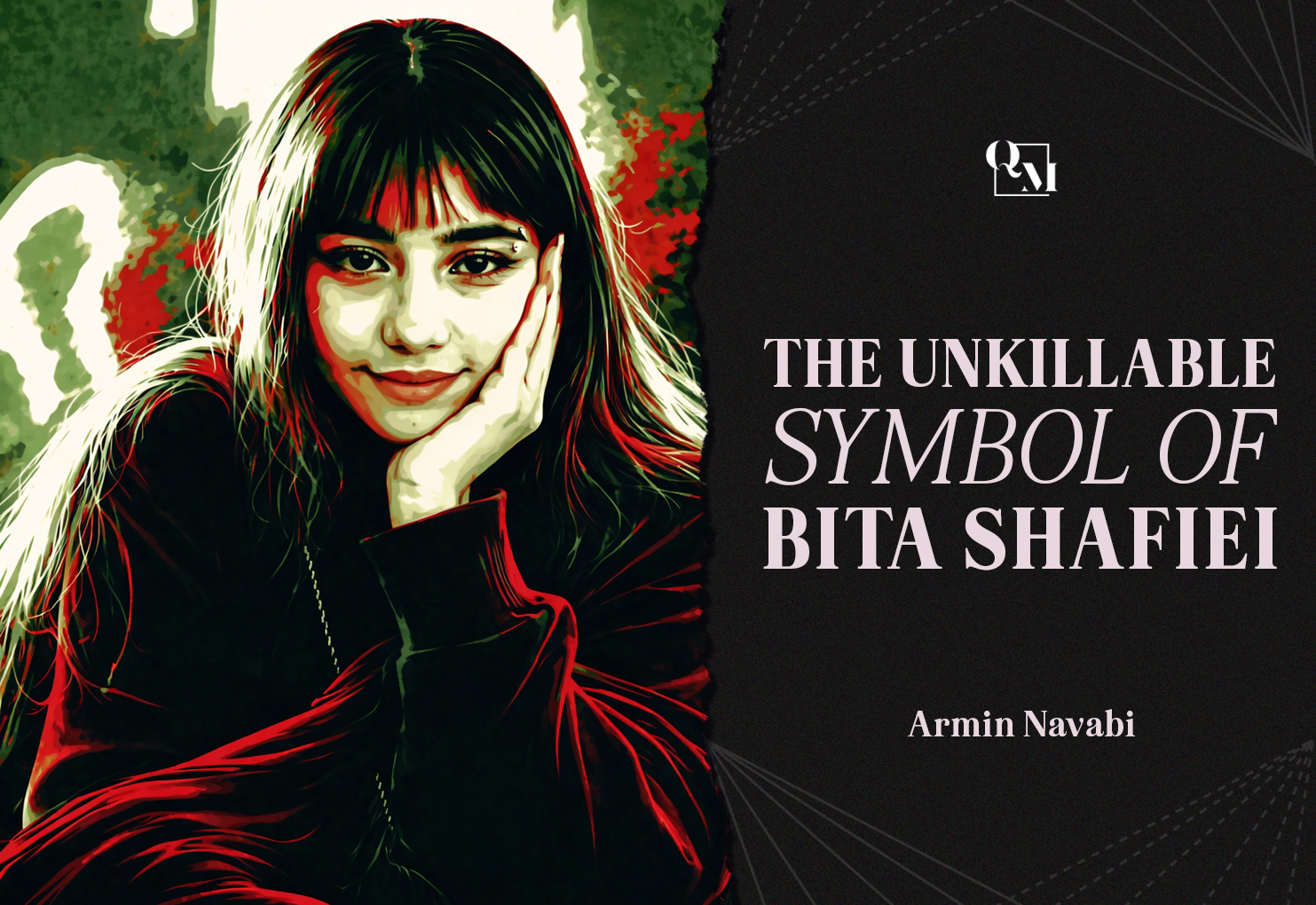
On November 10, 2025, a 19-year-old girl vanished inside Iran’s security machine, and the world barely noticed. There was no warrant. There was no court date. There was no explanation. Security forces connected to the Islamic Revolutionary Guard Corps tracked her down, abducted her, and transferred her to an undisclosed location. Since then, her family has received no word, not even a fabricated criminal charge. She is now in “incommunicado detention.” In the Islamic Republic, that phrase is a warning. It means she is being held somewhere with no oversight and no access to the outside world, where torture is not only possible, but expected.
The regime wants this to feel routine. Another young woman taken. Another dissenting voice eliminated. Another reminder to everyone watching that courage has a price. But this case is different. The girl they took is Bita Shafiei, a young anti-regime activist whose videos spread widely among Iranians because she speaks with ruthless directness, calling the regime “nothing” and urging people to stop being afraid, even after she and her mother had already been targeted and imprisoned. She did not need to post content constantly to command attention. When she appeared, she appeared with purpose. And it is exactly that symbolic power that frightened the Islamic Republic enough to make her disappear.
Bita is part of the Mahsa Amini generation, a wave of young Iranians who decided that fear is no longer an acceptable way of life. But even within that generation, Bita stood out. What made her known across Iran was how brutally blunt she was. Her videos were not cautious, coded, or polite. They were openly hostile to the Islamic Republic, with no attempt to soften her rage or hide her contempt. She broadcast to millions what most people inside Iran only dare to say in private. She spoke to the camera as if the regime had no power over her. She ridiculed its authority, challenged its legitimacy, and called on others to stop living in fear. In a country where a single sentence can lead to prison, she built her entire public identity on voicing the sentences everyone else is afraid to utter. Bita’s videos resonated so deeply because she was finally saying out loud what millions were thinking.
Her phrase (referring to the regime), “they are nothing,” captured the force of her message perfectly. In three words she attacked the foundation of the regime’s rule. The Islamic Republic depends on the illusion of invincibility — on people believing it is untouchable. Bita portrayed it as a fragile system built on a house of cards that only survives because the populace has not yet realized how much power they actually have. That shift in perception is deadly for any dictatorship, and she delivered it with the confidence of someone who had already accepted the risks.
First, the regime tried to break her. In spring 2023, she was arrested and held under pressure. They also detained her mother, Maryam Abbasi-Nikoo, holding her for weeks, including time in solitary confinement, and then sent her to prison as a way to punish Bita through her family. Yet she did not stop speaking out. She returned with more clarity and resolve. For many young Iranians, she became the face of a simple idea: that you can look directly at this regime, refuse to bow your head, and still say what you believe. That is why she matters. That is why her disappearance feels like an attack on the entire generation she represents.
The Islamic Republic does not fear tanks, armies, or foreign pressure the way it fears young Iranians who refuse to be intimidated. Its entire survival depends on manufacturing fear, not legitimacy. So when someone like Bita appears, someone who openly mocks that fear and shows others that the regime bleeds like anything else, she becomes a direct threat to the system’s foundation. What most terrified the regime was not merely Bita’s words, but how she delivered them. She spoke with a level of confidence that is almost unheard of inside Iran. No hesitation. No subtext. No attempt at caution. She did not treat the regime with the reverence or trepidation it demands: she treated it with naked contempt. That alone is political warfare in a dictatorship. It defangs the regime from a monster into a joke and a laughingstock. And jokes spread faster than propaganda. The moment ordinary people start to laugh at a dictatorship, its days are numbered. Bita was a force multiplier accelerating that process.
After her earlier arrest, she described being tortured, including having her fingers fractured, as well as the kind of intimidation that has driven many young Iranians to self-destruction. Most people would have disappeared from public life forever after an ordeal like that. Bita didn’t.
For a while, she stayed out of the spotlight, not because she surrendered, but because the regime had weaponized the one thing she could not ignore: her mother’s safety. They believed they had neutralized her. They believed fear had finally worked. They miscalculated.
After years of carrying the trauma of what the regime did to her and her mother, Bita made a decision that changed everything. She came back with a new video and crossed one of the Islamic Republic’s most dangerous red lines. She openly supported the government’s secularist opposition leader, Prince Reza Pahlavi. She did not imply, hint at, or signal it. She declared it. She put herself on the front line, knowing exactly what the price would be.
Pahlavi may be the son of the last ruling Shah prior to the 1979 Islamic Revolution, but his political relevance today has nothing to do with nostalgia for monarchy. Most of his supporters were not alive during the Pahlavi era. His influence comes from something far more dangerous to the Islamic Republic. He represents a credible, unifying, secular alternative with values that directly contradict everything the regime stands for. Pahlavi openly calls for a secular political system in which religion has no authority over the state. He advocates for a liberal democracy chosen through free elections. He defends human rights without compromise, including minority rights, women’s rights, and LGBT rights — positions that strike at the very core of the regime’s ideology. He argues that Iran must end its isolation and build normal, peaceful relations with the rest of the world, including the West and Israel. In other words, he stands for the kind of Iran that the Islamic Republic fears most: a free, modern, open, democratic, and globally connected nation.
This is why his movement has grown so rapidly. Multiple surveys indicate that Pahlavi is the most popular opposition figure. In GAMAAN’s 2024 political preferences polling, Reza Pahlavi ranked first among opposition figures. An ERF.i survey went even further, showing a large majority of respondents “lean toward” him, though its methodology has been debated. Either way, the direction is clear: Pahlavi is the one name that repeatedly rises to the top, across different datasets and question formats. He is the only figure who appeals to both older Iranians who remember a functioning country and younger Iranians who want one. His message creates unity, and the regime survives only by dividing people. When Bita endorsed him publicly, the authorities understood the danger instantly. Supporting Pahlavi is not just a political opinion, but an attack on the regime’s psychological survival.
What happened to Bita after that did not follow even the regime’s own fraudulent legal procedures. The Islamic Republic does not run on laws. It runs on violence wrapped in paperwork. First, they arrested Bita’s mother — their way of pressuring someone who cannot be broken directly. Then they abducted Bita without charges, a warrant, or any notional trace of legal pretext. When the regime wants to intimidate, it announces charges. When it wants to break someone, it disappears them.
Incommunicado detention is not an arrest. It is a kidnapping by the state. There is no lawyer, no contact, no oversight, and no proof of life. Torture is routine, and for young women, sexual torture is a documented risk. The regime has done this for decades. It is doing so again now.
Bita Shafiei has become something larger than the regime expected. She has become more than a protester, a detainee, or a victim. She has become the symbol of an Iranian who has completely rejected fear. She forced people to see the Islamic Republic as weak, temporary, and close to collapse. A dictatorship fears symbols more than enemies because symbols spread. Symbols inspire. Symbols cannot be easily silenced.
Bita’s disappearance is a confession — that the Islamic Republic is terrified, that it is losing control, that its grip on legitimacy is slipping. The regime did not take Bita because she was insignificant. It took her because she was powerful. Within days, her disappearance sparked the “Free Bita” campaign, which spread across Iranian networks inside and outside the country, and even showed up in demonstrations in Europe demanding the release of her and her mother, the exact opposite of what the regime wanted.
Now the responsibility falls on us. Bita told Iranians directly, if they take me, be my voice. She knew this day was coming. She accepted that risk. A 19-year-old girl did her part. Now ours begins. The regime’s strategy depends on silence. If we stay quiet, they win. If we let her story fade, they win. If we let fear replace her voice, they win.
In one of her videos, she lip-synced a song about saying goodbye and hoping Iran would one day be free. It was not just a song. It was a message. She understood that her life could be cut short, and she still chose to fight. Her disappearance is not the end of that story. It is the beginning of our responsibility.
Remember her words. Remember her defiance. Remember her name.
This is what she stood for. This is what they tried to silence. And this is what we must carry forward.
Update (Dec 28, 2025): Bita Shafiei was released on bail on Dec 27, 2025, after weeks in detention following her abduction on Nov 13, 2025. Her mother, Maryam Abbasi Nikoo, remains detained by the Islamic Republic in Iran, kept as leverage to intimidate Bita into silence.
Published Dec 26, 2025
Updated Dec 28, 2025