The Degenerate Populists and the Trad Elites
As Donald Trump dragged American conservatism down the path of populism over this past decade, the downstream effects have been as remarkable as they have been predictable. As the Republicans rejected expert consensus, flouted political norms, and abandoned all decorum, the party lost its grasp on educated, affluent voters and quickly devolved into the party of choice of the less-educated and the working class. By the 2024 election, the negative correlation between income and GOP votes was unlike any the US has seen going back to at least 1948.
Source: Patrick Flynn and Focaldata.
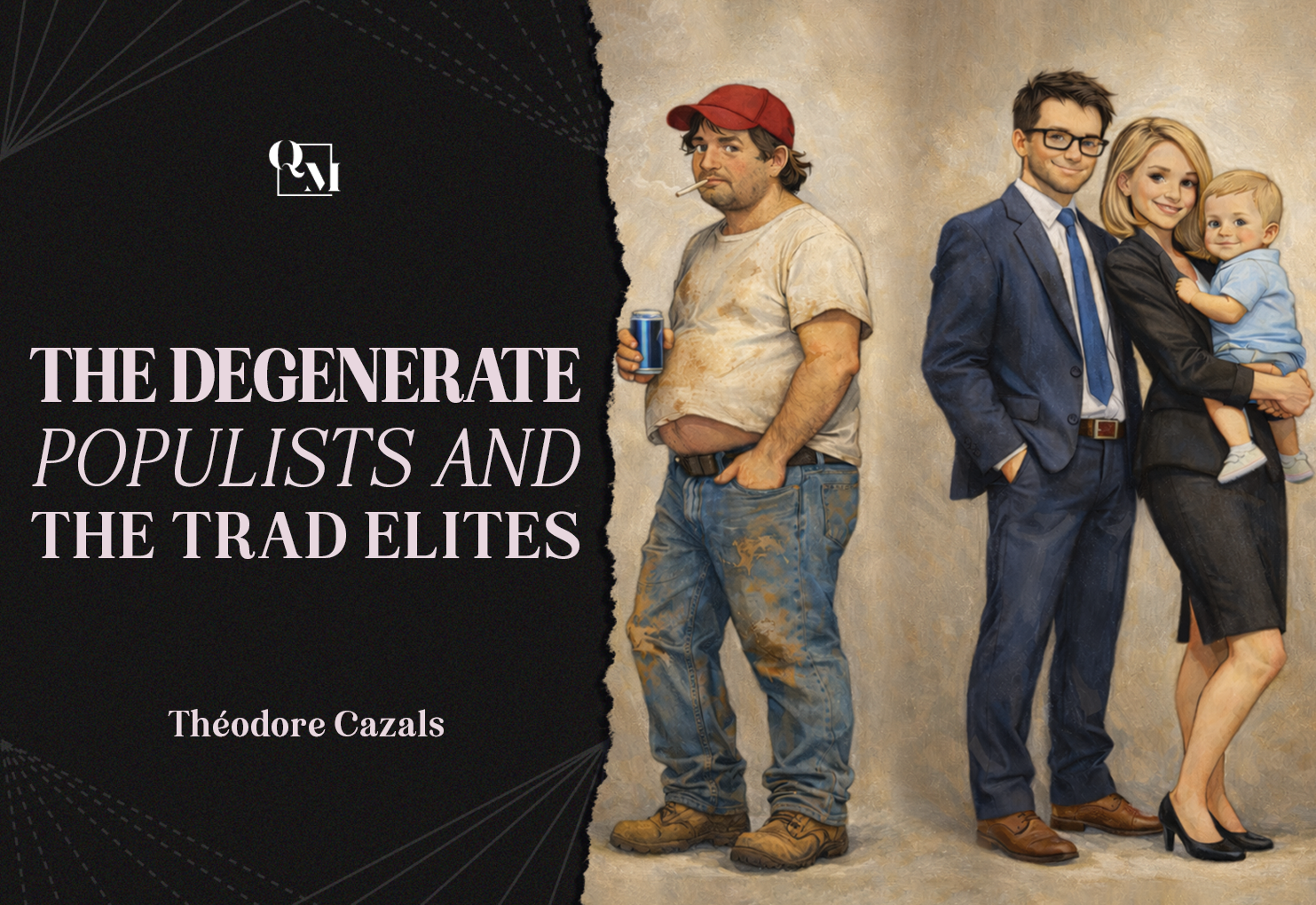
This trend has defined American politics for three consecutive presidential elections, and according to the Economic Innovation Group, in 2024, President Trump continued to gain ground in counties with high rates of poverty and unemployment and lower levels of education. This has led to an entirely new political right — and not just in socioeconomic terms. Today’s right-wing electorate now increasingly consists of people whose lifestyles bear little resemblance to the traditional “family values” that American conservatism has so long claimed to represent. The left’s voter base, by contrast, now embodies a comparatively idyllic picture of stable family life.
Education, it turns out, has an inverse relationship with what many on the political right would dub “degenerate” lifestyles, such as higher rates of divorce, children born out of wedlock, and substance abuse. Research shows that non-college-educated women are 38 percentage points less likely to have a first marriage lasting at least 20 years than women with bachelor’s degrees. Similarly, the unprecedented and much-bemoaned decline in marriage rates among young adults is disproportionately concentrated among the working-class, themselves Trump’s main voter base. A 2018 survey found that 77% of Americans with incomes over $100,000 per year were married, compared to 46% for those whose incomes were $26,000 to $40,000.
Even in parenthood — which is so strongly associated with the working class that the 2006 film Idiocracy, about a future Earth populated by morons, based its entire premise around this idea — is much more common among educated women. And when it comes to fertility rates, the long-standing pattern of the working-class having more kids than the wealthy is in the process of reversing, with the top income brackets leading the way. Measured purely by political ideology, conservatives still have more children than progressives, but if the educational and socioeconomic realignment of the right and left continues, we could see this trend flip before long.
A relatively new term describing these shifting dynamics has appeared in left-leaning corners of social media: “America B.” It represents another America, completely foreign to the ecosystem of politically-engaged posters, part of a more lowbrow and mostly uneducated populace. Their media consumption, now heavily influenced by artificial intelligence (so much so that fully AI-generated songs, like the now widely memed “We Are Charlie Kirk”, have reached the Billboard charts in the “Christian Songs” category), baffles “America A” by the sheer scale of what they see as “slop.” It’s important to note that these terms don’t simply refer to “Republicans” and “Democrats”, although there’s obviously some overlap. In a way, this contrast parallels Trump’s lifelong desire to gain respect among an upper crust that has never been receptive to his crass style and gauche affinity for gold-plating and imitation Baroque decor.
So on one hand, there’s Trump’s obsession with upper-class aesthetics, his desire to be accepted by the elite establishment, and then his populist outbursts every time they spurn his brutish personality and lack of cultural capital. Then, on the other hand, this very attitude has attracted the attention of a lower class who feels represented and morally absolved by Trump’s vulgarity and disrespect for the norms that have driven the political class for so long.
The white working-class vote, now the pillar of the conservative coalition (even with the gains made among black and Latino men), may be magnetically drawn to Donald Trump, but can the party survive his departure? Will Trump have to be cryogenically preserved or transformed into a Futurama-like talking head in a jar to continuously run in presidential elections as the lifeblood of the conservative movement? The predicament is that the new right, ironically, feels more diverse than ever. As a 2023 study found, the right’s tent has grown so big in large part due to the lack of a unified conservative theory. In a post-truth environment that rejects expertise, institutional consensus, and scientific norms, anyone can “do their own research” and find their own theory of everything. This is how you get a party that gathers “groypers” and diehard Zionists, libertarians and big-state nationalists, tech bro futurists and “tradwifes.”
The result of all these strange bedfellows is a coalition that’s now less likely than liberal elites to get married, more likely to get divorced, have children outside of marriage, search for gay and transgender porn, and abuse drugs and alcohol. More likely, according to the political right’s own rhetoric, to be degenerates.
Source: Child Trends.
Trump has been uniquely skilled in unifying these factions, but his most likely successor, if pundits and prediction markets are to be trusted, is Vice President J.D. Vance. The former Never-Trumper, who rose to fame with his 2016 book Hillbilly Elegy describing his childhood in the destitute areas of Appalachia, was largely dismissive of the white working class, blaming their woes in part on a poor work ethic and the collapse of religion. If he is to take up the Trumpian mantle, he must prove equally proficient at getting voters to disregard his past.
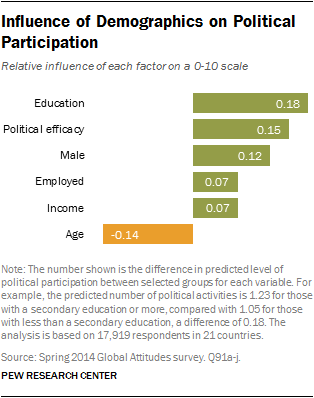
Ironically, while this appeal to the common man has allowed Trump to win the popular vote in 2024 — only the second time a Republican has done so in the past 38 years — it has made the GOP the party of low-propensity voters. Poorly educated, low-engagement citizens who don’t bother voting unless it’s a presidential election now reliably vote red. That confers Democrats a huge advantage during midterms and special elections, which arguably saved them from a disaster in 2022. This, once again, is downstream from the education and income polarization reinforced after 10 years of Trump dominating the political field. The lack of education and lower average income translates to a lack of information and civic engagement.
The GOP’s continued electoral success will depend on its ability to resonate with low-status voters whose lifestyles are anything but conservative. Whether they can pull this off without Trump, or whether they will, at long last, unravel into a discordant howl of incoherent cultural grievances, remains to be seen. For the time being, if you want a picture of traditional American family values in action, look to liberal elites.
Published Jan 15, 2026