
Monogamy? In This Economy?!
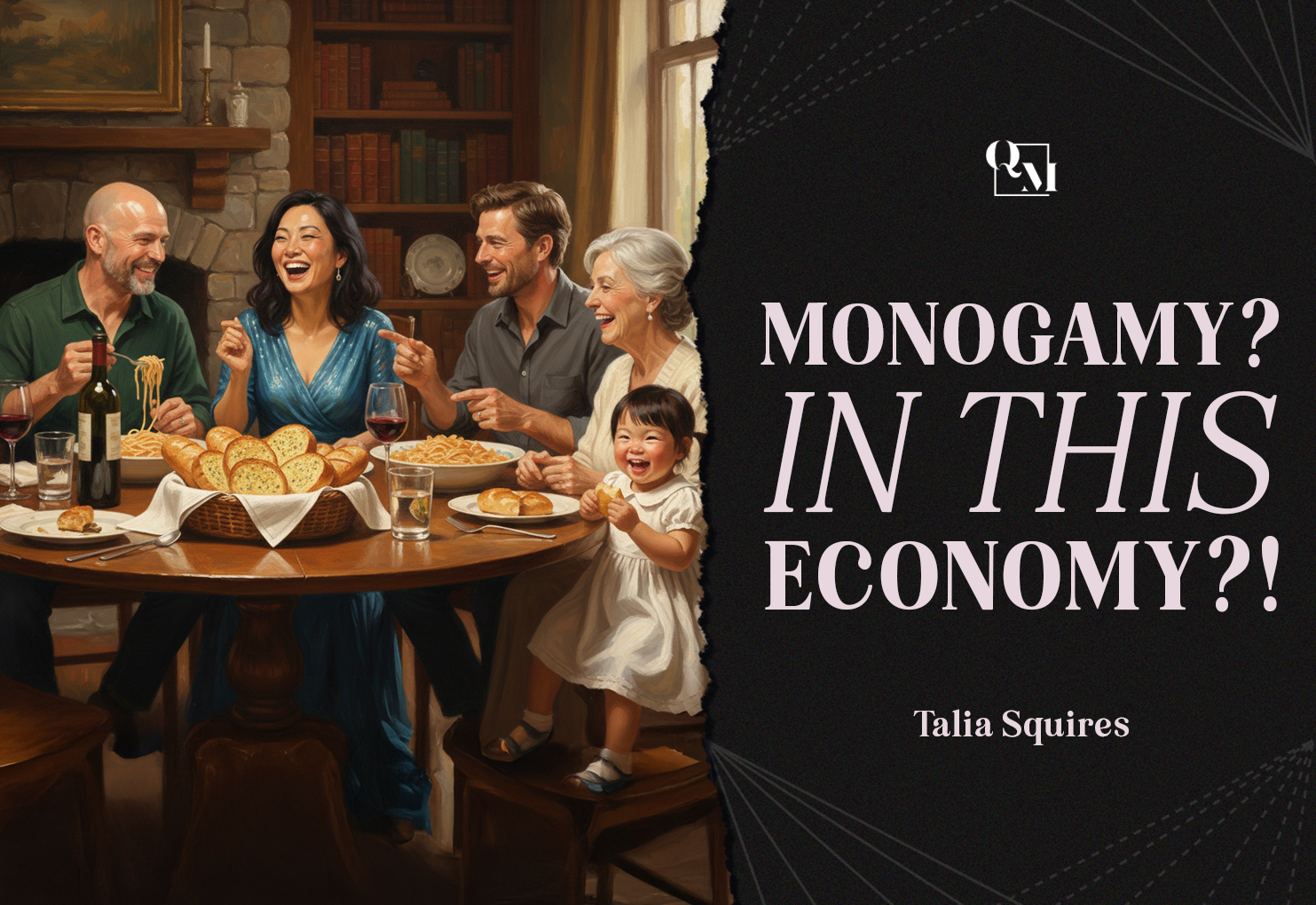
Monogamy? In this economy? It’s been a joke in our polyamorous household for years now. When we took the leap and started IVF, the security of that third income was what made us brave enough to become parents. When we upgraded our house to fit not only my husband and me, but my partner, my mother-in-law, and hopefully a child, knowing that we were all contributing made that financial leap feel possible.
One of the greatest things about being a part of the queer community is that once you start challenging one assumption about sexuality or romance, it gets much easier to challenge others. Accepting that I was bisexual and realizing that it was totally normal made it infinitely easier for me to challenge the idea that monogamy should be the default. This, in turn, made it easier for me to embrace the idea that a household can be more than just two romantically linked adults and their offspring. Family can mean whatever you make it, and I’m lucky to have such a large and loving family all under one roof.
I felt especially fortunate when I became one of the tens of thousands of US workers directly replaced by AI. And let me tell you, it sucked. I had blithely assumed that I was safe from the takeover by our machine overlords. I thought there was no way that AI, as it stands now, could curate custom book lists for kids of diverse backgrounds. Bookelicious disagreed. And so, I started the holiday season by filling out unemployment paperwork, health insurance forms, and job applications. Having that extra working adult in the mix meant everything. It meant we wouldn’t have to worry about whether our bills would be paid, our child would have Christmas presents, and our geriatric dog would continue to eat his bougie dog food. We probably won’t be dining out in fancy restaurants, traveling, buying tickets to events, drinking expensive wine, or remodeling our very 1960s house anytime soon. But those are things we can live without. Having two other people on my team helping me sort everything out made my sudden unemployment merely stressful instead of catastrophic.
When you consider the rising cost of housing, groceries, and healthcare, it’s no wonder that financial security feels more tenuous than ever for many people. Long gone is the era of the single-income family — people now require two incomes simply to survive, without even thinking about kids. And the moment children enter the picture, things get very expensive very quickly. The problem is, if both partners need to work, someone needs to watch the kids, and affording childcare can feel equally impossible for many families.
The children’s advocacy group Zero to Three found that in 39 states and Washington DC, center-based child care for infants and toddlers is more expensive than in-state college tuition. In 45 states, care for two children costs more than the average mortgage. And that’s assuming that you can even get your kid into a quality child care center. Hop on any pregnancy group on Reddit, and families are putting themselves on waitlists as soon as they get that positive test result. In fact, when I was going through IVF, there were families in the IVF groups I’d joined trying to get on a waitlist before they’d even done an embryo transfer.
Even in the lowest cost-of-living states like Mississippi, child care has become an expense many cannot afford. Source: Economic Policy Institute.
I’m blessed to have a household that isn’t just polyamorous, but intergenerational. Having my mother-in-law move in after her husband's death has enriched our family life even further. My daughter now gets to grow up with her grandmother, creating bonds most kids miss out on. I also get an experienced mother to tell me that my daughter is indeed the most perfect child ever born and that she’s probably just teething and not dying. Living with someone who has experienced so much life has helped give me a little more perspective on the hurdles I face in my own. She also might just be the nicest woman in the world.
Our Christmas mornings are riotous. Along with my partner, my husband, my best friend, my husband’s long-distance boyfriend (and his husband), my parents, my mother-in-law, and my now-toddler, our gatherings take on what can only be described as wondrous, joyful chaos. For us, family is not limited to romance; it's about embracing everyone who matters in our lives.
Just as important as the financial support, the ability to spread out the labor of running a household has simplified everyone’s lives. Yes, we have a few more bathrooms to clean, and updating the family calendar takes a little longer, but we all spend less time figuring out what’s for dinner, doing pharmacy runs, and waiting for that guy who hooks up your Internet.
Source: YouGov.
I was lucky enough to find a new full-time job pretty quickly, but it meant giving up on working from home and returning to the office. Everyone has rallied to make sure our daughter is cared for, dinner is ready, and the chickens are fed. It’s a stressful change, but knowing that someone else is scheduling doctor’s visits and finding an in-network dentist makes it so much easier. It also means that when my husband or partner needs to travel for work, I’m able to kiss them goodbye knowing that I won’t be alone with a toddler, three dogs, and eight chickens.
In contrast, I often wonder how my monogamous friends are managing their lives during these challenging times. We all graduated from college into the recession of 2008, and after long years spent clawing our way out of debt, we finally started to feel safely middle-class as we entered our 40s. Then we became the same mid-level white-collar remote workers that are now being cut by the thousands. Despite my master’s degree and strong résumé, the job I finally landed — a receptionist — only requires a high school diploma. There’s no shortage of jobs in the economy, but good jobs are hard to come by.
My family arrangement gives us the privilege of resources. My mother-in-law and parents are thrilled to step up and provide 40 hours a week of childcare. This has given us the luxury of not only focusing on our financial health but also on our emotional well-being as well, which leads to choices that prioritize happiness and stability without the impending fear of economic collapse looming over us.
Even without the romantic element, folks often wonder what a married couple did wrong if they share their home with other adults. Mother-in-law horror stories and the long tradition of conflict between women and their husbands’ mothers have become their own cultural genre. But my mother-in-law didn’t land on our doorstep destitute; we’ve always known that we wanted her to live with us someday. And my partner isn’t the random roommate we needed to afford the mortgage. Finally, having room for all of us under one roof was always the plan. It hasn’t been without its growing pains. Bringing all our lives together means that we have too much stuff and will probably be sorting through it until the end of time. We all have different sleep schedules, and making sure folks are getting enough shut-eye has been an ongoing project. We have different socialization needs, different pet peeves, and different levels of crunchy parenting aspirations (spoiler alert: I’m the aspirational crunchy parent). But we can’t imagine living any other way.
We’ve also had to work to create legal protections for our child and all of the adults in our household. When two people get married, inheritance, medical decisions, shared benefits from work, filing taxes, and so many other legal practicalities are sorted with a standard marriage license. For the increasing number of families that don’t have that simple legal shorthand, things are more complicated. We filled out reams of paperwork to ensure that all three of us are legal parents to our daughter (thank you, California), including advance healthcare directives, estate planning complications, and more. It’s an ongoing project, but an important aspect of making sure that our support for each other is enduring, even should the worst happen.
We’ve talked endlessly, adjusted, compromised, and adjusted again. But there’s a real argument to be made for creating a supportive community wherever you are and accepting that these can take work. Many parents talk about wanting a proverbial village, but less so about how they’re actually building that village. Whether it’s through romantic connections, multigenerational households, or dear roommates — take that support where you can find it and treasure it.
Humans were not meant to do this alone. We weren’t even really meant to do it in pairs. The idea of two adults facing the world alone together is relatively rare throughout history and across cultures. It’s easy to see why. Having one person as your entire support system is a lot to ask of them, and there isn’t much of a backup plan if that one person falls ill, suddenly dies, or just flakes out on you.
Of course, families like ours are relatively uncommon. While some stats suggest that more and more people are practicing some kind of ethical non-monogamy, this can include everything from “hall passes” to swinging to 20-person polycules. In 2022, the Kinsey Institute found that one in nine people in America had experience with ethical non-monogamy, but didn’t break that down into what type of ethical non-monogamy or specify if they were currently practicing. A 2023 YouGov survey found that 55% of Americans’ ideal relationship structure is strictly monogamous, 11% were unsure, and 34% wanted something other than complete monogamy. 8% were interested in “complete non-monogamy”, a laughably vague concept, but I probably fall in that 8%. In short, someone you know has probably been ethically non-monogamous at some point in their life, but I’m often the first person someone has met who lives with two partners.
When people learn about my unconventional family, I’m often met with questions. Foremost among them is: “How do you all make it work?” I always look at the folks asking and wonder the same about them. Life seems like a herculean task with just two people. To me, the real question is: in this economy, can we afford to be monogamous?
Published Jan 22, 2026