
Don’t Flush: An Interview with Dakarai Larriett
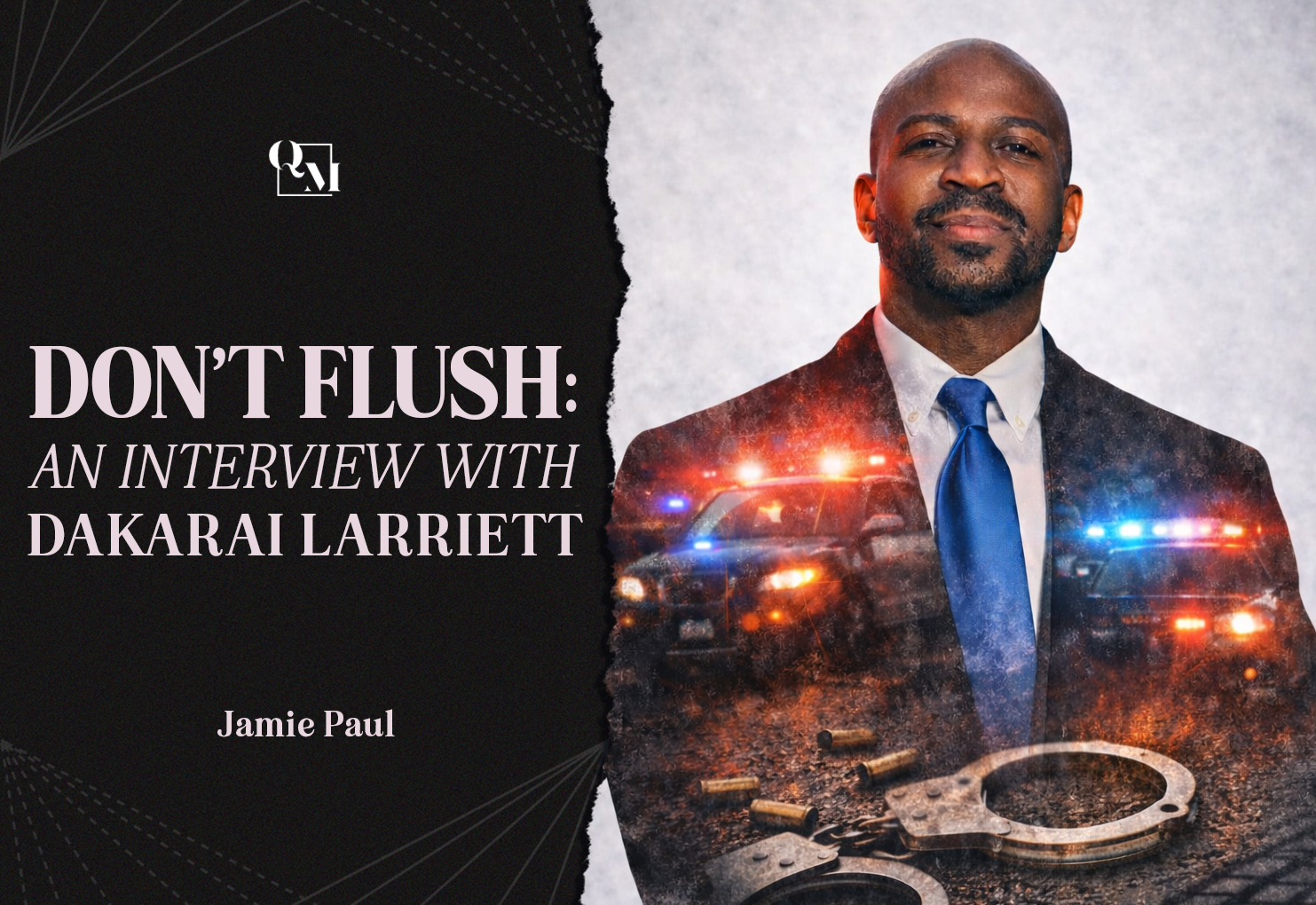
Progress, Dakarai Larriett told me, is “not linear.” Viewed from a great distance, the trend line of human history might look like a ramp ascending into the sky, but zoom in closer, and what we see are countless fluctuating ebbs and flows. The world doesn’t just get better on its own. Often, progress is born in the steps we take in the aftermath of a downtick. At the most granular level, individuals making choices to turn pain into healing and injustice into principled reform are the engines that drive us forward together. This is what Dakarai Larriett is trying to do.
On April 10, 2024, Larriett, a then-executive at Whirlpool, was pulled over by the Michigan State Police. Over the course of the next several hours, he was given a battery of field sobriety tests, subjected to snide remarks about his sexual orientation (he’s a gay black man), accused of being a drug mule, and taken to a local hospital for blood tests. He was even forced to defecate in front of police, who yelled “don’t flush” repeatedly. More disturbing still is a segment of released body cam footage that appears to show a state trooper allegedly attempting to plant drugs in Larriett’s vehicle. Larriett was charged with operating under the influence despite passing every test, though the charges were later dropped in the absence of evidence.
This is the kind of ordeal that leaves many people embittered, even radicalized. Larriett’s reaction was different. It was a galvanizing moment that inspired him to run for Tommy Tuberville’s vacant Alabama Senate seat in the upcoming 2026 midterm elections on a flagship proposal to strengthen the rights of motorists nationwide. I sat down with Dakarai to discuss his background as an army brat-turned-entrepreneur, his experience that night in Michigan, why body cams haven’t brought the accountability many had hoped for, the movement to defund or abolish the police, reform versus revolution, the backlash against LGBT rights, and more.
***
Jamie Paul: We obviously have to talk about the terrible night that led to your political campaign, but before we do, I was wondering if you could discuss your backstory.
Dakarai Larriett: Well, I'm a born and raised Alabamian. My mom’s a teacher, my dad worked in the army, and his work took us all around the world. I grew up in California, Oklahoma, Washington State, Germany, and then moved back to Alabama. After college, I couldn’t find work in Alabama and moved to New York City, where I built a career in supply chain and worked for companies like L'Oreal and Louis Vuitton. I also spent about 20 years serving on community-based nonprofit boards like the Harm Reduction Coalition (fighting the opioid crisis) and the Bronx Community Pride Center — the largest LGBT organization in the Bronx, focused mostly on ending homelessness for young LGBT folks. I moved back to Alabama during the pandemic, balancing my corporate supply chain career with a pet care business I’d started back in 2012.
JP: When you were pulled over in Michigan that night, were you working there?
DL: I worked for three years for the Whirlpool corporation, which is based out of Benton Harbor, where the incident happened. I was going back and forth between Alabama and Michigan at the time. I was actually already in the process of moving back to Alabama full-time.
JP: You've spoken in many interviews about the racial component to what happened that night. Do you think there was also a homophobic element to it as well?
DL: Yes, absolutely, but it took me a little bit longer to accept that. It’s hard to see in the dark video, but I was with a friend that night — he was in the passenger seat — and we talked about the incident later on. I asked him, “What bothered you the most?” He mentioned all the comments about us being “fruity.” It was clearly a homophobic slur. A night or two after the incident, my friend and I found the trooper’s Twitter profile. It was full of homophobic and transphobic posts going back for years and years. That kind of sealed it for me. So when we ultimately decided to sue the [Michigan State Police] in October of 2024, we submitted his social media history and appended the complaint with discrimination for perceived sexual orientation.
JP: It's striking that with all the attention police abuses have received over the past 15 years, and the fact that officers now often wear body cameras whose footage is obtainable, that incidents like these still occur.
DL: This is why I'm drafting the legislation I call the Motorist Bill of Rights. In summary, it proposes that every traffic stop has to meet one of the agreed-upon federal reasons to stop someone, like federal probable cause. Right now, we have a patchwork system. If you’re driving through a tri-state area, you don't know the rules in this state or that state, much less in the towns you pass through. And when someone is pulled over, there should be a scientific basis for any tests administered to them. I was put through seven sobriety tests that night by one officer and two or three visual inspections by the other one. So let's say 10 field sobriety tests. We had some experts look at this later, and they were like, “This doesn’t even prove sobriety, it's just more evidence gathering.” Later that night, I tested negative [for intoxication] through a blood draw. I wasn't even given the courtesy of a breathalyzer.
To the second point you raised, we spent a lot of money to obtain the body cam and dash cam video. In my case, I waited five and a half months for FOIA to release the footage to me, and what they sent was redacted and obviously edited. The footage is literally titled “Redacted”, so there's no disputing that. The third component of my bill says that when incidents like this happen, the people involved and their families should be able to obtain the unredacted video within 24 hours at no cost. I had to pay $600 to get this garbage. In fact, we even sent it off to two audiovisual analysts, and they were like, “This is not evidence, it's missing metadata. This part's muted, that part is black. What is this?” It's the defense for the police. My case was initially thrown out by a judge in a lower court of Michigan. Think about it: they patched together this story, they redact what is inconvenient, and then the judge makes a summary judgment, which amounts to “qualified immunity.”
JP: Wait, the judge never actually evaluated the full footage, only the edited and redacted portions?
DL: Exactly. We never even got the video of me being tortured in jail, being forced to use the restroom publicly, being yelled at, or being accused of drug trafficking by ingestion in my stomach! I’d never been arrested before. I'm a Fortune 500 corporate executive. Get out of here, right?! So they patched together the story, fed it to the judge, and the judge dismissed it. It's a complete racket. That’s what we've got to fix. They're using the body cam and dash cam against us now.
JP: I watched your police video online. It might have even been on your own YouTube page. It was close to an hour. Even at that length, that’s still the redacted version?
DL: Yes. I think that's quite convincing, but that's redacted. That's the first hour, which is essentially me being racially profiled. And you'll hear a lot of different insults. [The video] doesn't show anything after we got to the jailhouse. The whole interaction started with them making fun of my name. One trooper called out my name with this very exaggerated and embarrassing accent. And then the other officer called me [instead of Dakarai] “Daiquiri, Daiquiri. I hope you're not drinking Daiquiris.” And it just proceeded from there. At one point, I was asked my highest level of education. I said I had a master’s degree, and he goes, “Oh, so you know, your alphabet.” The entire time, it felt like they were just trying to provoke me. To this day, the Michigan State Police asserts that this was a professional interaction with no infractions at all.
JP: Take me through your decision in the wake of this to run for US Senate.
DL: I just kept hitting a wall. There was all this evidence [of wrongdoing]. Even the redacted video was so clear that it went viral on YouTube and USA Today. That wasn’t enough to get the [Michigan] Attorney General Dana Nessel to do anything. I had three meetings with Governor [Gretchen] Whitmer's office. They said they don't have jurisdiction. The prosecuting attorney, the one who cleared me of any charges, refused to put charges against the troopers or to even return a phone call or email. I was so frustrated. I said, you know what? I'm going to write the laws to fix this. And as I was beginning the process, I realized this is a national issue.
There was a killing by the police, not even five miles away from my house, and the family has been denied the video for months. The footage they finally got was edited down to five minutes. It's very clearly not the original video, and the family is still in the process of trying to obtain the full footage. I want to fix this problem. As I started speaking to Alabamians, I realized there's also so much frustration around all those kitchen-table issues that impact all of us, like education, health care, and the economy. People just feel left behind, like the system isn't working for them.
JP: You're now running on a platform, at least in part, of police reform. As you know, there's been a lot of debate in recent years about defunding the police. Some activists have even called to abolish the police. That approach has caused a great deal of blowback. I was wondering if you could speak to your approach and philosophy on the “reform versus revolution” debate when it comes to law enforcement.
DL: I think that we have to be more pragmatic and solution-oriented. We have to bring folks together. I'm building relationships here in Birmingham. I know our police chief here in the city, as well as our sheriff for the county, and these are the kind of folks you have to work with. We need legislation that ensures accountability, not laws that just punish or attack the police. There are really great people in the force protecting us every day. I have a cousin in the FBI here in Birmingham, and another in the Birmingham Police Department. So I think it's incredibly irresponsible to talk about disbanding the police. We need the police, but we've got to be accountable. And I think having that third aspect of the Motorist Bill of Rights — releasing information to people immediately and without redactions — will be a step in the right direction.
JP: Alabama is obviously a very deep red state. But at the same time, the narrative around political polarization can be misleading. There really is a lot of common ground that most Americans agree on, but because of the way it's coded, people sometimes think that they don't agree with something that they actually might. How do you intend to bridge divides and make common cause on the things most people really do agree on?
DL: This campaign is really about kitchen-table issues. We polled people. Not just on who they're intending to vote for, but what matters to them. It's education, health care, and the economy. So we're building out those detailed proposals to develop a 51% policy platform that we can take to voters in November. We know that we're going to have to bring in people across the spectrum.
JP: Something that we've covered here a lot at QM in the last few years is the so-called “vibe shift.” There's been a backlash against sexual freedom. Obviously, trans issues are kind of the elephant in the room. But even if you look at the opinion data, attitudes are declining around support for same-sex marriage. Gallup asked people whether gay or bi relations were moral, and those numbers are declining. Not to mention all the stuff we’re seeing online. What are your thoughts about this trend and how we can lower the temperature and get back to a more small-l liberal place?
DL: What I'm seeing here in Alabama is that gay folks are represented at every level of government. Some people are more out than others, and that's just normal. But my state representative, Neil Rafferty, is an openly gay man and veteran. We can do anything we want in this state. I’ve found such comfort here in Birmingham. Our trans brothers and sisters are definitely being attacked — we're seeing that with Attorney General Steve Marshall. One of the things we're trying to do with the campaign is talk about our Christian values. Alabama is a very Christian state [89%]. So we're connecting the dots for people in the messaging and building that relationship with the faith community around the idea that these are our brothers and sisters. Let's support them, not demonize them.
JP: What are your thoughts on progress as a concept? Do you think the US has made strides toward becoming a fairer, more accepting, more tolerant society? Recognizing progress is often a point of contention left of center, as some people feel it dampens the energy behind new reforms.
DL: You know, it's a step forward, and it's a step back. It’s not linear, and we have to realize that. And I think when you have elections like 2024, those trigger slingshot years, which I think 2026 will be. I've seen progress. When I started coming back to Alabama after living in New York, I went to the mall one day, and I saw so many mixed-race couples. That was not something I saw growing up here in the ‘80s and ‘90s. We're seeing that with LGBT people here in the state. In fact, a trans woman ran for state representative in the last one or two cycles here in the state. So we are being represented everywhere. It’s moving in the right direction, but can we move it a little faster? That’s what I’d like to help with.
Published Jan 28, 2026


