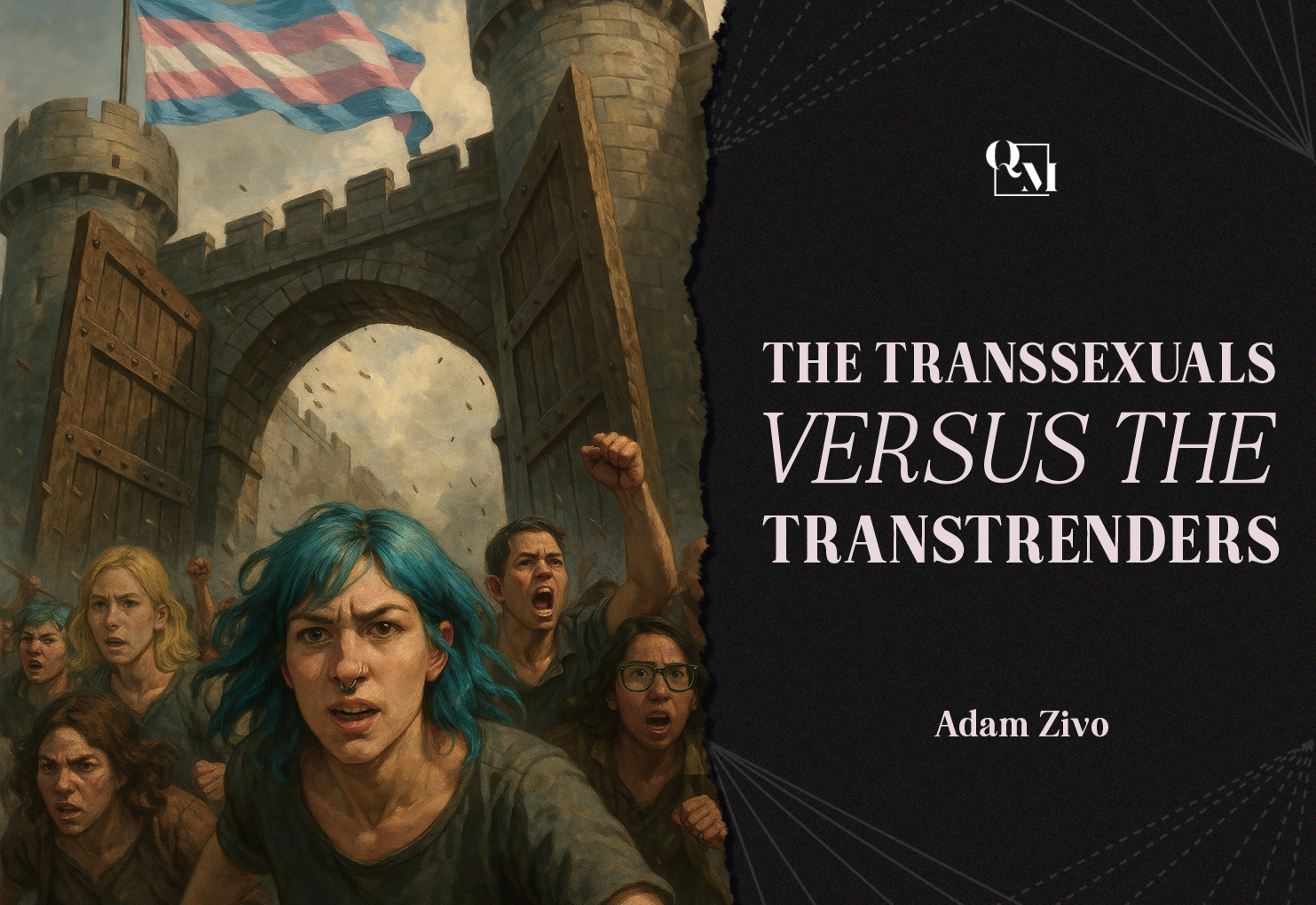
The Transsexuals Versus the Transtrenders
The bitter debate over gender ideology often obscures a simple, but vital, truth: there are many different ways to be trans, and not all of them are equally deserving of accommodation. It is possible to criticize some of the more contentious factions of modern transgender activists, along with the radical ideologies they espouse, while maintaining empathy for old-school transsexuals who just want to quietly assimilate into society. Taking this nuanced approach invites certain challenges, but it is morally necessary if we are to find a fair resolution to these culture wars.
The kinds of transsexual people I’m referring to here are those who suffered from persistent and agonizing gender dysphoria and who treat this condition by undergoing medical transition and living unassumingly as the opposite sex. As with any social group, this community is politically diverse. Yet, on average, they do not make spectacles of themselves. Most neither advocate for gender radicalism nor deny the importance of biology. They ask not for revolution, but for peace within existing social structures and access to appropriate healthcare.
Source: KFF/The Washington Post Trans Survey, 2023
These transsexuals have lived among us for decades, often incognito, without much fuss. I have known several such people throughout my life — as friends, acquaintances, and coworkers — and found them perfectly decent people, as ordinary as you and me.
Some were so well-assimilated that I had no idea that they were trans for quite some time. Until recently, these “traditional” transsexuals seemingly constituted the majority of the trans community and ensured that it had a coherent identity and purpose. They espoused a “transmedicalist” ideology wherein being transgender is considered a diagnosable condition that requires carefully supervised treatment. Their demands for social accommodations (e.g., using bathrooms of their choice) could be controversial, but were still intelligible and relatively sympathetic — mostly because this group earnestly tried to “pass” as the opposite sex.
However, as the social cachet of being LGBT grew during the 2010s, transsexuals were supplanted by a wave of newcomers, consisting mostly of natal females, who identified as trans on far less substantial grounds. Many in this cohort were deeply traumatized or neurodivergent (e.g., autistic) individuals who abruptly latched onto transgenderism to cope with their own pain. Others seemed eager to call themselves trans simply so they could reap the social benefits of being perceived as intersectional and “oppressed.”
This emerging population often lacked the longstanding, unbearable gender dysphoria that is integral to transsexualism, and, relatedly, did not feel a strong desire to medically transition or attempt to pass as the opposite sex. This, in turn, raised questions, both within the trans community and without, about whether they were in fact trans or merely the products of what social scientists term a “social contagion.”
And so, in an apparent bid to consolidate their own legitimacy, the new cohort radically redefined transness and insisted that people are automatically trans based solely on their own self-identification. Rejecting any further litmus tests, they argued that trans people do not need to experience dysphoria or pursue medical transition, and that they should be free to adopt whatever pronouns and gender expressions they’d like.
Under this new, amorphous “self-ID” framework, virtually anyone could call themselves trans. Fetishistic crossdressers who watched too much anime, and bored heterosexuals who whimsically decided they were “non-binary,” could barge into the community unencumbered. Bearded males who used “he/him” pronouns and showed no desire for hormones or surgery christened themselves “trans lesbians.” “Xenogenders” (supposed genders that exist beyond the masculine-feminine spectrum) were adopted by trend-hungry poseurs who insisted that others refer to them using “neopronouns” such as “ze/zir” and “bun/bunself.”
This crowd sometimes argued that the old, medically oriented model of transgenderism should be rejected because many gender-dysphoric people can’t afford hormones and surgeries. If a low-income natal male suffers from dysphoria and feels compelled to live as a woman, then shouldn’t they be considered trans, even if they lack the financial means to medically feminize themselves? These were fair criticisms. Yet, they were always on the periphery of a radical movement that, for the most part, fixated on abolishing the “barrier” of gender dysphoria in all cases.
By the mid-2010s, an intracommunity dispute broke out online, primarily via social media platforms like Tumblr and Reddit. Older, traditional transsexuals accused the younger cohort of being illegitimate “transtrenders” who wanted to appropriate the “trans” moniker for social clout. They argued, quite presciently, that maintaining a strict definition of transgenderism and grounding the community in medical transition was essential for preserving social legitimacy and acceptance. Yet, the fast-growing “trans can be almost anything” faction smeared the transmedicalists as “truscum” and accused them of engaging in “gatekeeping”, bigotry, and “cisheteronormativity.”
The transmedicalists ultimately lost, which was perhaps inevitable. Not only were they seemingly outnumbered, but their assimilationist tendencies meant that they were, almost definitionally, less visible than their transtrender adversaries. Worse yet, major LGBT institutions and media outlets — such as GLAAD, Pink News, and Them — sided against them and declared transmedicalism profoundly “harmful.” As one author wrote in a recent article for Them: “The idea that trans people who do not fit the narrow mold outlined by transmedicalists are an obstacle in the fight for healthcare isn’t just wrong; it polices trans people’s bodies in the way that the state already does.”
But without the anchoring power of transmedicalism, transgender activism devolved into a caricature of its former self.
What had begun as a plea for the humane treatment of a tiny, medically distressed population became a carnival of gender absurdity. The comparatively modest accommodations requested by transsexuals — such as allowing fully transitioned individuals to discreetly use bathrooms matching their identities — were expanded into a full-out, tone-deaf assault on common sense and sex-based rights.
Whereas some (but not all) cisgendered women are comfortable sharing some spaces with fully-transitioned transsexuals, they were now being asked to accommodate males whose commitment to being “trans” ended at putting on a wig and dress. Many of these males proudly — defiantly, even — flaunted their “girldicks” in women’s changerooms and flooded onto lesbian dating apps. Their conception of womanhood was often highly sexualized and caricatural. Their behaviour was domineering, fetishistic, and laden with misogyny.
Taking advantage of the “self-ID” model, some male criminals even strategically presented themselves as transgender after being arrested so that they could be transferred to women’s prisons. They were indulged, because to reject their claims would undermine the central tenet of the new movement: that anyone can be transgender simply if they say so.
The non-binary crowd proved particularly problematic. Although its members claimed to be trans, it was plainly obvious that most were just cis people seeking attention and cosplaying oppression. This group included progressive gay, lesbian, and bi folks who suddenly discovered “they/them” pronouns the moment classic homosexuality stopped being transgressive and hip, alongside milquetoast straight lefties who claimed to be “queer” and “trans” after getting a bad haircut and septum piercing. Together, these people lectured the rest of society — including actual transsexuals — on the need to accommodate their theatrics, further alienating erstwhile supporters.
Whereas traditional transsexuals, driven by the need to assuage their dysphoria, generally prioritized integrating into society and avoiding subversive disruption, the transtrender crowd advocated for the exact opposite and demanded that the rest of society bend to their fringe ideologies. It went down like the sociocultural equivalent of replacing Coca-Cola Classic with New Coke.
When support for trans rights surged in the late 2010s, most of the public still seemingly operated on a transmedicalist mindset. For example, advocates for progressive bathroom policies regularly used images of fully-transitioned, “passing” transsexuals to make their case. “Isn’t it strange to put this hairy, muscular trans man in a women’s bathroom?” they asked, quite reasonably. This became a recurring theme. Ironically, the successes of the transtrender movement were in large part propped up by the traditionalist transsexuals who had just been politically marginalized and vilified.
But the public eventually recognized the bait-and-switch. People realized that the “trans” individuals it had just empowered were not the transsexuals of yesteryear, but something else entirely. So now we have a backlash — especially among women who had committed to “being kind” under the assumption that their spaces would be respected.
But amid this seething anger, an important fact has been missed: many transsexuals never asked for any of this. They just wanted to transition, live quietly, and be left alone. Their dreams were of private happiness, seamless and mundane, not universal revolution. They did not want to have their community co-opted by a flood of clout-chasers and disordered youths. Now they find themselves scorned because of a movement that they often disagreed with and were partially exiled from.
Defining and achieving reasonable and fair accommodation for transsexual people still needs to be worked out, but one thing remains clear: they deserve empathy, because they, too, were victimized by the “transtrender” crowd, and were sometimes among the first to criticize them.
Published Dec 09, 2025